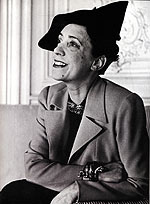
A multiplicity of “fashion firsts” are attributed to Elsa Schiaparelli. Probably the first clothes designer to have opened a prêt-à-porter boutique, she was not only the first to collaborate with the leading visual artists of her day, but also the first to seek notoriety outside her field by dressing sports and movie personalities. An inspirational exhibition at the Musée de la Mode et du Textile, revisits this remarkable fashion “first” lady’s achievements.
Once upon a time, many decades ago, there existed two titans in the world of haute couture: Coco Chanel and her rival, Elsa Schiaparelli. Chanel liberated women from whalebone corsets and bustles, and put them in simpler, more comfortable outfits devoid of excessive frills and unnecessary details. Schiaparelli, on the other hand, joined forces with the Surrealists in an effort to create what amounted to works of art, often poking fun at high fashion in the process.
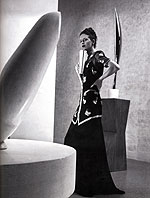
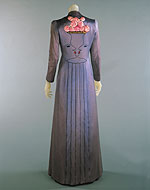
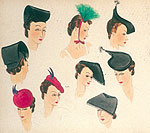
Hats were shaped to resemble shoes, gloves had “painted fingernails” woven in and lobsters sat atop the shoulders of jackets, replacing epaulettes. In the New Yorker in 1932, Janet Flanner wrote “a frock from Schiaparelli ranks like a modern canvas.” Often considered a “fashion jokester,” the Paris designer herself liked to define dressmaking as “an art” rather than “a profession.”
Between the previous century’s two World Wars, Schiaparelli was known as an avant-garde trailblazer who had a sense of originality combined with a zest of madness and extravagance, reflected in her trompe l’œil sweaters with skeletons knitted in, newsprint dresses and African motifs. Her designs became even more outlandish as she enlisted the help of her artist buddies. She posed for Man Ray, working with HIM AND the likes of Dali, Cocteau, Dufy or Marcel Vertes, notably on projects connected with everything from garments and jewelry to advertising.
Born in 1890 to a family of Italian intellectuals and scholars, Elsa left Rome to live in New York’s Greenwich Village in 1919. The modernity of her existence — surrounded by skyscrapers and the brouhaha of city life — and a social circle that included Man Ray, as well as Edward Steichen, Francis and Gabrielle Picabia had a profound impact on her work. The “strikingly original sweaters” presented in Paris in January 1927 were an overnight success: among these, a black-and-white pullover decorated with an eye-fooling bow heralded as “an artistic masterpiece” by Vogue.
In 1935, Schiaparelli established a salon overlooking the Place Vendôme with its imposing statue of Napoleon. By 1937, the butterfly — a symbol of change from ugliness to beauty — had become one of her key “signatures.” But, the ultimate metamorphosis she brought to women’s wear was to create a “total look.”
To present her thematic collections, Elsa Schiaparelli turned her fashion shows into theatrical events that dazzled the “Tout-Paris.” Many of her designs challenged the silk and satin “perimeters” of traditional haute couture, incorporating man-made fibers with futuristic names like Rhodophane, an innovative plastic. Viewing attire as a form of architecture, she believed it should be closely linked to the frame of the body, just as a building’s shape is drawn from its structural skeleton. Consequently, her silhouettes were frequently described as possessing a distinctively streamlined not to say strict “neatness,” with angles replacing feminine curves. Elsa Schiaparelli created practical gear for aviator Amy Johnson on her solo flight to Cape Town in 1936, culottes for tennis champion Lily d’Alvarez that outraged the English lawn tennis establishment in 1931, not forgetting her own interchangeable travel wardrobe.
After World War II, Schiaparelli endeavored to rework earlier themes, yet soon found herself upstaged by a rising generation of eager young couturiers like Balenciaga and Dior. Her house was declared bankrupt in 1954 and — despite several attempts to revive it — its status has never subsequently risen above that of a brand name associated with classic scarves and accessories.
Initially seen at the Philadelphia Museum of Art, this exhibit showcasing 250 garments, drawings, embroideries, pieces of jewelry, film illustrations, works of art and photographs of her output is a “first” in itself — the first major retrospective to reveal Elsa Schiaparelli’s contribution to couture, and the extent to which her creations mirrored the social, political and cultural climate of her times.
Mar 7 to Aug 29, Tue-Fri 11am to 6pm, Sat-Sun 10am to 6pm, Musée de la Mode et du Textile, 107-111 rue de Rivoli, 1er, tel: 01 44 55 57 50, 6E