 |
|
|
|
|
|||||||||
|
|||||||||||||
 |
|||||||||||||
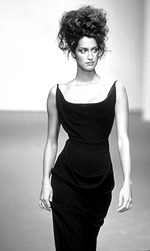
Westwood dress |
|||||||||||||
 |
|||||||||||||
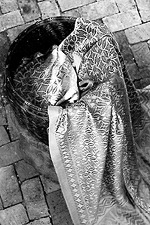
Joyce Gallery expo |
|||||||||||||


by Carol Mongo |
||||||||||
|
|
|
|
|
|
|
|
|
|
|
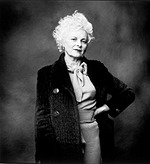
VIVIENNE WESTWOOD |
||||||||||
 |
||||||||||
|
||||||||||
This fall, fashion folks won't have to look too far to find something to occupy their time. When rainy days settle over the city and the leaves begin to drop, you can count on the city to sparkle with a number of exhibitions ranging from Vivienne Westwood at the Franck et Fils department store to a display of sumptuous paisleys at the Musée des Arts de la Mode and everything in between.
Once Upon A Time There Was Vivienne Westwood... On October 23, the Queen of Punk, Vivienne Westwood, will be launching "Boudoir," her first perfume, in the French capital. Six days later on October 29, she will make a personal appearance at Franck et Fils (80, rue de Passy, 16e, Mº Passy). The store will host an exhibition retracing her creations via clothes, photos and film from October 29 until November 14. On October 29, fashion shows featuring Westwood's "Gold Label" (semi-couture) and "Red Label" (ready-to-wear) will take place in the store at 2:30, 3:30, 4:30 and 5:30pm. From that date until November 14, 20 provocative dresses chosen from the Gold Label collection will be projected on an enormous screen on the walls of a small room. These photos show off the exaggerated silhouettes of her "mock buttocks" (Winter '95-'96), "Vive la Bagatelle" (Spring 97) as well as the pure lines of her clothes inspired by the "New Look" or "Five Centuries Ago" with a touch of Renaissance (Fall/Winter '97/'98). To further celebrate the event, the rue de Passy windows will feature models dressed in "Gold Label" and "Red Label" creations as well as accessories and perfume against a backdrop of 18th century paintings, flirting with the public much in the same way they do on the catwalks in London and Paris.
Pia's Post Machine Avant garde designer Pia Myrvold is staging a week-long exhibition titled "Post Machine" for her summer 1999 collection. Post Machine takes off where Myrvold's other interactive clothing collections (Dada Memory 1997 and Osmoses 1998) stop. Her prints are made from photos of old "interfaces" such as typewriters, radios, record players and telephones. By showing these images on the clothes, she prepares for "future ware" where these functions will be directly incorporated into the clothes. For Pia, Post Machine is also a philosophical statement. She is interested in a fashion that guides creative thought and action into a multifaceted cultural environment so that the model is not merely a face, but a creative unit. For this exhibition, which runs from October 14-19 at 15, rue Martel, 10e (at the back of the courtyard), Pia worked in collaboration with video artist Delphine Charrveau to create a "fashion show" in which the images of the models are projected onto the walls. The expo also features a series of large-scale textural paintings by the designer. Professionals and the public are invited to the vernissage and music presentation on October 14 from 6-10pm. Those who can't make it to these events can still get a glimpse of her collection by surfing over to her website: www.pia-myrovold.com.
Light From Java Until November 20, a show at the Joyce Gallery (Jardins du Palais Royal: 9, rue de Valois, 1er, Mº Louvre/Palais Royal) spotlights the talents of textile designer Baron Manansang. Set against a backdrop of primitive Javanese furniture, some sculpted from a single tree trunk, this spectacular exhibition is sure to captivate anyone who loves looking at beautiful fabrics. Fascinated by Asian art in general and enchanted by Indonesian art in particular, Baron Manansang started as an ardent collector of Javanese ancient fabrics and antiques before becoming an art consultant and later creating some prodigious textiles with precious details. After acquiring a wealth of knowledge of traditional motifs and a sharp control of ancestral manufacturing methods, he created his own technique for producing the materials which he transforms into stoles, scarves and sarongs. During this process, silk yarn is hand-cooked before being prepared for weaving. The warp is then mounted onto the same style manual wooden loom that has been used by generations of skilled weavers. Each piece requires from two weeks to a month of work. For example, to produce his batiks, Manansang draws patterns over the entire cloth. Some vegetal inks are poured on the line or surface to color with the help of a narrow funnel. When a specific color is totally applied, it is covered with wax to be protected. This step is repeated with successive colors until at last the pattern is completed.
"Cachemires Parisiens: A L'Ecole de L'Asie, 1810-1880" While on the subject of textiles... from October 9 through February 28, the Musée Galliera (Musée de la Mode de la Ville de Paris, 10, av Pierre 1er de Serbie, 16e)s will host an exhibition totally dedicated to some of the most extraordinary paisleys of the 1900's. During the last century, young women dreamt of wearing paisley shawls. Like jewelry and lace, shawls were part of a woman's trousseau. Astoundingly, the price of these precious items equaled that of a fur coat or a diamond ring. In 1982, the Musée Galliera presented a thematic exhibition illustrating the use of paisley patterns originating from India in woven designs, prints and embroidery produced in Edinburgh, Paisley, Norwich, Paris, Lyon and Nîmes. Now, more than 15 years later, the public is being given an opportunity to discover an updated selection of these marvels, mainly manufactured by prestigious British and French weavers inspired by shawls imported from Kashmir. While some of the most exquisite curatorial discoveries included in this magnificent display were featured in the Exposition of Industrial Products of the last century, all of the exhibits borrow their sumptuous motifs from the Islamic arts, transformed in thousands of different ways... Separated into nine sections, the exhibition leads the visitor from Guillaume Ternaux's creations worn at the royal court in 1812 to early fringed polychromatic designs and industrially manufactured shawls, and also focuses on prestigious pieces from China, Egypt, Great Britain and France, presented at various World Fairs in Western Europe during the mid-19th century.
|
||||||||||