

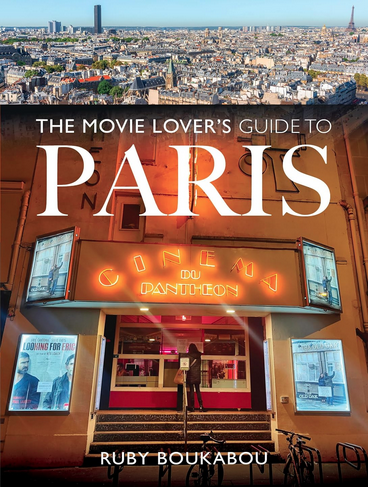
 For movie buffs and Paris lovers alike, “The Movie Lover’s Guide to Paris” is the ultimate companion for experiencing the City of Light through the lens of a cinema. With over a century of cinematic history, Paris has been a muse for filmmakers, inspiring countless poignant moments on screen. With this book you can step into the frame and experience Paris like you’re a part of the action. Continue reading “Paris For Movie Lovers”
The Latin Quarter Revisited
Discovering the 5 & 6th district
 Romantic myths of Left Bank intelligentsia which date back seven centuries are brutally shattered on today’s busy bd St-Michel, the main artery of the Latin Quarter, where the 5th and 6th arrondissements meet.
The venerable Sorbonne, the quarter’s historic seat of intellectual life, is still there, but these days the forlorn chime of its chapel bell, which has punctuated the studies of generations of scholars, is drowned out by the din of passing traffic. Indeed most people who stream past the place de la Sorbonne seldom notice its beautiful 17th century chapel with its graceful dome. Continue reading “The Latin Quarter Revisited”
Paris Cemeteries, the Saints Go Marching

November in Paris begins with yet another long weekend away from work – le pont de la Toussaint (All Saints Day) – one of many strewn along the French calendar year. As Paris florists bring out their stock of chrysanthemum for the annual commemoration of Parisians now gone, and as other Parisians pack their cars and pile up at the exits of the city for yet another frantic weekend on France’s chock-a-block highways, why not use this most appropriate time of year for a less stressful outing to one of the capital’s cemeteries. This should be completed with the purchase of Georges Brassens’ “La Ballade des Cimetières,” a perfect way to record your outing and do your French homework. Continue reading “Paris Cemeteries, the Saints Go Marching”
Paris’ Secret Vineyards
 Until recently, much of Paris was a collection of villages, fragments of which can still be detected by the sharp observer. Needless to say, their wine-loving inhabitants covered a substantial portion of their territory with vineyards… to everyone’s joy.
Bastille day…The story behind the celebration
 It was on the southern edge of the arrondissement, in the wretched Faubourg St-Antoine that rumbling discontent was first channeled into working-class consciousness and into organized action against exploitation. When word was spread on April 28, 1789 that Monsieur Réveillon, a painted-paper manufacturer on rue de Montreuil, was planning to reduce his workers’ wages, the Faubourg St-Antoine rose up in a violent insurrection. Monsieur Réveillon had not anticipated such a reaction, for the lowering of wages he had intended was proportionate to the drop in the price of bread fixed by the authorities to ease social tension. His 400 workers had a different idea of fairness and Réveillon, terrified, ran for his life and sought shelter in the neighboring Bastille, the ominous fortress looming west of the faubourg. It took the intervention of troops and a death toll of 30 to put down the revolt, but any wise ruler should have sensed that further trouble was brewing … Continue reading “Bastille day…The story behind the celebration”
The Art Lover’s Guide to Paris
 A great book by veteran Paris reporter Ruby Boukabou — “The Art Lover’s Guide to Paris” — is a wonderful companion for a trip to Paris whether or not you are familiar with the city’s amazing art offerings. Continue reading “The Art Lover’s Guide to Paris “
Paris 17th district
 Of all the 8 new arrondissements incorporated into Paris in January 1860 (13th to 20th), the 17th is Baron Haussmann’s creation par excellence; for, despite the ‘deep chasm’ that seprated north from west, no arrodissement was as true to the new middle-class spirit of the Second Empire (and later the Third Republic) or promoted the values it stood for to the same degree. Continue reading “Paris 17th district”
Storming the Bastille
 Discovering the 11th district In 1976 the painter Dominique Thiolet settled in a new studio at 5 rue de Charonne, ushering in a new era for the 11th arrondissement. The arrival of other artists in the southern section of the arrondissement around the Bastille and the renovation of the area were the first step of an overall process of gentrification of eastern Paris. Continue reading “Storming the Bastille”
The Goutte-d’Or
 A tiny patch of Africa transplanted to Paris, the Goutte-d’Or is one of the last remnants of genuine working-class village life in Paris. Despite desperate struggles by local associations to rescue it from the hands of technocrats determined to “clean up” the area, demolition has already begun and the usual characterless buildings of our times are cropping up, notably the new police station, easily distinguishable by its tricolored flag. Continue reading “The Goutte-d’Or”
Paris’ ten most romantic spots

Pont des Arts Lovers photo:Bob Bishop
We all have our “favorites” as to where to play out our love stories, and a city like Paris has certainly scores of these. But remember that choosing the right time of day or night, the right season and the right weather can be as important as the “stage” itself, which should never be crowded. It’s meant to be just the two of you, and Paris… What a superb threesome you make! Continue reading “Paris’ ten most romantic spots”
Paris’ 18th district
Montrmartre, Pigalle and la Chapelle — Crime and the passion of social ideas; anarchists and artists; sex, drugs, rock ‘n’roll and working class heroes … Paris’ 18th arrondissement has seen it all. Its history tells the tale of some of the major social forces shaping life in this city. Continue reading “Paris’ 18th district”