|
 |
|
Food for the soul
by Scott Steedman

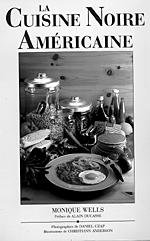
La Cuisine Noire Américaine
How do you find a live catfish in Paris? This was one of the questions Monique Wells asked herself when she began researching her book on African-American cooking, just published in French as “La Cuisine Noire Américaine.” She started with the fishmongers on la rue Mouffetard, where she lives, but they recoiled in horror: “Le Poisson-chat? We throw those back!” The French view the catfish as a filthy riverbed vacuum cleaner, and would never dream of eating one.
She found frozen Asian catfish in the Tang Frères supermarket in Chinatown, but had almost given up on the fresh variety. Then one day she was exploring the crowded North African market at Château-Rouge, and there like a vision was a tank full of live catfish.
“They spear it and kill it for you on the spot,” she laughs. “Paris is a great city for food lovers. There are so many cultures here, so many roots and influences... You can find virtually everything if you are willing to hit the pavement.”
Born in Texas and raised in Louisiana, Wells moved to Paris with her husband in 1992, to perfect her French and continue her work as a pathologist for a pharmeutical company; today she tests the medical effects of cosmetics for L’Oréal. The idea for the book came out of her involvement in Sisters, a support group for African-American women in Paris which she helped to found. “We exchanged a lot of recipes,” she says, “and the question was always, where do you get that?”
‘The book is really about family and about the roots of food,” she explains. “Family” because most of the recipes come from her mother and cousin Sandra, with her father contributing his two specialities, chili and Texan barbecue. “Roots” because her family’s roots go back to Africa, France and Spain, and because there is a lot of history in the book, notably the history of créole and Cajun cooking, a rich brew of French, Spanish, Amerindian, and Caribbean influences. Not forgetting Africa: “During the time of slavery, slaves cooked everything, for the masters and themselves, in the way they had learnt from their parents, who were African.”
It took three years, three publishers and three tons of perseverance to get the book into print. She would never have done it without her translator, René Piétri, who liked the manuscript enough to continue working on it after the first contract fell through. He then showed it to famous French chef Alain Ducasse, who convinced his publisher to buy it, and wrote the preface. Wells laughs about the struggle now: “unless you’re a masochist, I would not advise it!”
But her refusal to accept second best has paid off. The French edition of “La Cuisine Noire Américaine” (Minerva, 240F) includes plentiful color photos and watercolors, and the American edition will be published by the prestigious New York editor Abrams in the year 2000. They want to call it “Soul Food,” though Wells prefer “Food for the Soul.”
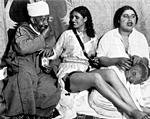
France’s year-long love affair with Morocco, officially titled Le Temps du Maroc and co-organized by Frédéric Mitterrand, comes to a glorious close with a new exhibition at the Hôtel de Sully. Called Le Désir du Maroc, it is a superb gathering of photographs of the country taken by Westerners over the last century and a half. All 175 prints are reproduced in a large format book of the same title (Marval, 390F), with introductory essays in French by luminaries including the Goncourt-winning novelist Tahar ben Jelloun.
For Europeans, Morocco has always been a land of mystery and sensuality, the enticing Orient par excellence. The earliest of these photos, from the turn of the century and before, are wonderfully evocative. Here are veiled harem women, bedouin warriors with curved daggers on their belts, the teeming souks of Fez and Marrakesh, a camel train at an oasis, intricate minarets and imposing forts. One anonymous photo from 1920, of a desert rider on his rearing steed, is particularly striking.
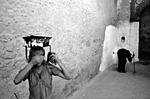
The later images are much less folkloric, treating the subjects as real people rather than exotic figurines. But is amazing how little has changed. Away from the cities, women are still veiled and wives dressed in dazzling nuptial jewelry. The lack of color adds to the feeling of timelessness.
Interesting to note the photographers include two Americans, the writer Paul Bowles, who has lived in Tangiers for half a century, and Paul Strand, who immortalizes the great door at Rabat as he did the skyscrapers of Manhattan.
|
|