I really feel like I’m set to enter the year 2000 with products I call “millennium goods.” They range from items with sleek exterior aesthetics to near science fiction functionality. Things like flat panel televisions with Web integration and crystal clear digital resolution, cameras that work with micro-chips instead of film and bantamweight computers and telephones. But when it comes to fashion, for the most part, I feel like a prisoner of the 1900s — against my will. The majority of fashion designers are still burying their heads in the sands of the 20th century. Most of what was presented for “summer 2000” last month forced their wearers on a nostalgic trip back to the 1970s... again. Convinced there was someone out there creating with the year 2000 in mind, I abandoned the big names and headed for Carole de Bona, Workshop and Atmosphere, trade fairs known for young stars of tomorrow. Not yet plugged into the high voltage system of the global glamor scene, many of their designers, including those featured here, represent a rising generation who is not afraid to use new fabrics or borrow ancient techniques to create a look that is quintessentially tomorrow.
MARC LE BIHAN
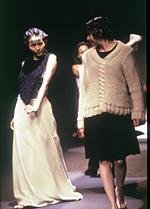
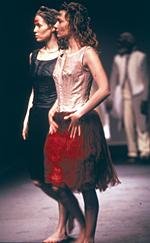
“For me, each collection is a prolongation of the previous one,” states Marc Le Bihan whose fashion shows are more of the order of contemporary dance theater. In what looks like, in part, a Martin Margiela-inspired line of antique frocks reworked with a slap of latex and combined with brand new garments cut from metallic fibers or given abstract splashes of paint, the old and new cohabit conspicuously. Marc is unpretentious about the somewhat organic “evolution” of his line. “I’m mostly interested in the body, using clothing as a support.” He adds, “the starting point is always the last collection. In fact, you’ll find remnants of past seasons’ collections in each new one.” Originally trained as a textile designer in tapestry and the restoration of antique textiles at the Gobelins factory, Marc later attended a decorative arts school for clothing design then went on to Central Saint Martin’s in London. With no prior experience working for a design house, he launched his own label nine seasons ago. Today he sells both his “show” pieces and commercial wear to 80 stores across the globe. “I sold my first summer collection to Bendel’s who took some of the special pieces to mix with the more commercial. That’s really the whole idea. I’m not for a total look. Each person or store takes what they want to create a look. I’m anti total look. My collection evolves in that sense.”
SUNYOO MOON
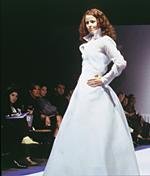
“I looked at traditional techniques and tried to replicate them using modern technology,” explains Sunyoo Moon showing off something she calls “high tech lace.” It’s a white skirt with flower patterns laser cut into the plasticized material. Born and raised in Australia, the Korean designer moved to Paris 15 years ago and studied fashion at Studio Berçot, a school known for its avant-gardism. She later worked for Cerruti, then Missoni in Italy, as a designer until last March. This being her first collection, she explains, “I created modern visuals using modern techniques. The cuts are studied and worked out to look easy and new.” Opposite the laces are garments with sharp graphic prints that could have been lifted from computer microprocessor chips. “My prints are modern visuals and graphics inspired by the beginnings of modernism dating from the 1920s and the Bauhaus movement. These are exclusive prints in which I tried to convey positive-negative aspects (black on white). The prints reflect current movements in architecture and modern art.”
SOPHIE HONG
Using something ancient to create something resoundingly new describes the work of Sophie Hong, a seasoned designer from Taiwan who has been in business for 20 years. Her collection is cut in ample lines with small details like perfectly bound jagged necklines, quilted jackets with tiger eye buttons, and short tops randomly pleated on the diagonal as if to build movement into the garment. What looks like distressed leather is in fact, lacquered or “muld” silk. On her stand at Atmosphere, she spotted me, then perched a cocoa brown and black rose on a marine blue lacquered silk coat to show me how everything harmonizes perfectly. Next she held up a one-shouldered dress, randomly pleated and top-stitched before summoning her sales rep Françoise to explain everything in French. “These are special pieces made by Sophie. The dying and finishing she uses is from a traditional technique once used in China which has since disappeared. She researched and reworked the technique herself. The fabrics as well as the colors are not found anywhere else. She makes the patterns (for the garments) and cuts the first model herself. She uses semi-precious stones — lapis lazuli, amber, tiger eye — for buttons. Even the reinforcement stitches are done in a contrasting color to give a more decorative appeal.”
KEN OKADA
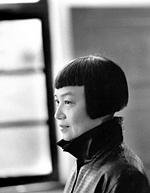
New on the scene and bursting with energy is Paris-based Japanese designer Ken Okada, a tiny little Japanese woman who is soft-spoken and looks no more than sweet 16. Situated near the front door as I entered Workshop, her collection consisted of lots of innocent white cotton shirts, black embroidered tulle tops and wide cut flat pants. Her career started in Tokyo working for Japanese designers for four years, then three years for western designers including Philippe Model. “I came to Paris as a student 10 years ago with the idea of creating my own company.” It wasn’t until she did an internship with Ralph Kemp that she felt the urgency to launch her own company. “Much of my inspiration comes from ideas from Japan. Clothes can be transformed from day to evening with a small detail — a jumper worn with a t-shirt for the day — that is transformed into an evening garment by letting the top drop down over the skirt. Also, I wanted a handmade aspect to my work. That’s why you’ll find lots of decoupage and embroidery.” Explaining the austerity of her line she points out, “the collection is black and white because it’s my first. Like that you can see the silhouette, size and volume. In my next collection I want to see more color. Deep colors of the street.”
DECO SUGAI
In a class all buy herself, Deco Sugai is eager to show off her second collection she calls, “Co-existence” presented at Carole de Bona. After studying design and merchandising at FIT in New York, Deco returned to Japan where she worked for Teijin, a firm designing and producing textiles for the international market. She launched her own firm in 1991 and has presented her first line as well as sportswear and textiles at the Tokyo Collection. Her true force lies in her textile background which shows through the unusual and inventive nature of her materials which this season ranged from nylon with a fishing wire warp, lacquered Japanese rice paper enriched with embroidery, bamboo fabric embroidered with a bamboo design in silk, and a special material made of organza, polyester and Japanese paper. “I created something new by marrying together various elements with totally different characteristics,” Deco points out. “But unlike the world of chemistry, there is no complete transformation of the original elements. No complete vanishing of the original elements. There is only a new harmony.” She adds, “Independent elements make each other more attractive and start singing together a same tune. Soon the tune will become a perfect harmony over a new horizon of fashion.”