

 While Paris has been making history in plain view a lot has happened under the paving stones. Located south of the former city gate (the “Barrière d’Enfer” at today’s Place Denfert-Rochereau), a subterranean labyrinth of former quarries holds the remains of six million Parisians, moved there after a decision in the late 18th century to close cemeteries within the city walls for reasons of public health. Opened in the late 18th century, the underground cemetery became a tourist attraction on a small scale from the early 19th century, and has been open to the public on a regular basis from 1867. This guide written by Gilles Thomas with photographs by Emmanuel Gaffard takes us through the vast ossuary maze of sombre galleries and narrow corridors laden with walls of bones where limestone was once mined. The official name for the catacombs is l’Ossuaire Municipal. Although this cemetery covers only a small section of underground tunnels comprising “les carrières de Paris” (“the quarries of Paris”), Parisians today often refer to the entire tunnel network as “the catacombs”. A fascinating guide to the dark side of the city of light. J.M
Parigramme, (12 euros). http://www.parigramme.com
 Voltaire once said “It is not enough to conquer; one must learn to seduce.” Most anglos have a negative view of the word and would agree with the Merriam Webster Dictionary definition that seduction implies “the enticement of a person to sexual intercourse or the act of leading aside… “But Elaine Sciolino with her new book tells us that for the French there is a lot more to the story. In France —especially Paris— seduction is a way of life with its own set of rules and codes that take most people who are not born here a lifetime to figure out.
  The Chateau de Versailles covers over 200,000 square meters. It is one of the best-known heritage sites in the world comparable to such icons as the Taj Mahal and Beijing’s Forbidden City. Versailles was the center of political power in France from 1682, when Louis XIV moved from Paris, until the royal family was forced to return to the capital in October 1789 after the beginning of the French Revolution. Versailles is therefore famous not only as a building, but as a symbol of the French monarchy.
 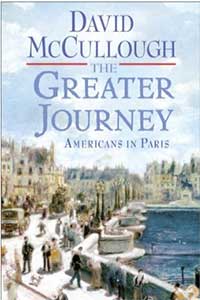 Historian and author David McCullough’s new book revisits the adventurous American artists, writers, doctors, politicians and architects who set off for Paris in the years between 1830 and 1900 to see what France could teach them. McCullough, who has been called a “master of the art of narrative history, is a two time winner of the Pulitzer Prize for “Truman” and “John Adams.”
  Woody Allen is not alone in loving Paris. The city is the most visited capital in the world. Its many monuments dotting the cityscape are always a feast for the eyes. Now a new book including short descriptve text in English with color photographs by Chicurel and Pascal Ducept portrays the splendors of the city of light from the Notre-Dame de Paris to the Louvre to lesser know jewels such as the Hotel de Sens with seldom seen views. “Paris Monuments,” published by Parigramme selling for only 19 euros, is one of the best new Paris picture books to come along in awhile.
  Helen Constantine’s “Paris Metro Tales” offers 22 remarkable short stories set throughout Paris—all connected by the underground tunnels of its famed Metro. The journey begins at the Gare du Nord, stops at 20 underground stations along the way, and ends at Lamarck-Caulaincourt, each story corresponding to one of the 20 arrondissements of Paris.
  Since 1997 John Lichfield, The Independent’s correspondent in France, has been sending dispatches back to the newspaper in London. More than transient news stories, the popular Our Man in Paris’ series consists of essays on all things French. Sometimes serious, at other times light-hearted, they offer varied vignettes of life in the hexagone and trace the author’s evolving relationship with his adopted country.

 These poems are like polaroid pictures depicting my favorite Paris neighborhood, Saint-Germain-des-Pres,” says the young French author Nicholas Grenier describing his new book of Tanka-style poetry titled “Quant à Saint-Germain-des-Pres, trente et un tanka sur la main d’apres.” Grenier’s approach to Tanka poetry both honors Japanese tradition and takes it in some new directions. While employing the classic 31 syllable 5-7-5-7-7 Tanka structure he departs from tradition by using urban images instead of pastoral ones creating colorful impressions of the Left Bank district. “When I am out walking around Paris my feet take me to Saint-Germain-des-Pres,” says Grenier, “It’s my Paris reference point. I write about things I observe there from the Café de Flore to Monoprix. It’s a new, modern kind of Tanka.”