

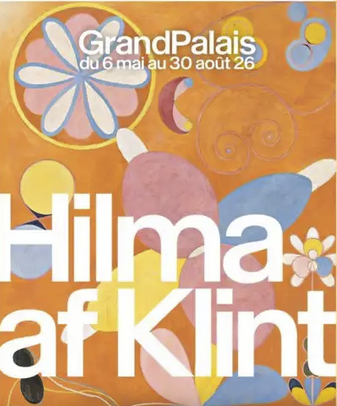
 Swedish artist Hilma af Klint (1862-1944) is a pioneer of abstraction comparable to Kandinsky or Malevich. But it is only recently she has started receiving the attention she deserves. In her will, she left all her abstract paintings to her nephew. She specified that her work should be kept secret for at least twenty years after her death. As things turned out it was much more than that.
Her work was first seen in 1986, at the exhibition “The Spiritual in Art: Abstract Painting 1890-1985” at the Los Angeles County Museum (LACMA). Things really took off with the Guggenheim Museum “Paintings for the Future” 2018 show. With the “Hilma af Klint, “Les Peintures du Temple (1906-1915) exhibition at the Grand Palais, Parisians now have an opportunity to discover this amazing artist (until August 30, 2026).
From her large-scale compositions to her secret avant-garde works, her art blends color, form, and symbolism with captivating audacity. Trained at the Royal Academy of Fine Arts in Stockholm, Hilma af Klint led a double artistic life: a figurative practice that conformed to the expectations of her time, and, in secret, a radically avant-garde production nourished by theosophy and spiritualism, exploring cosmic harmony and invisible forces.
From 1906, long before Kandinsky or Malevich, she created bold compositions in which vivid colors, geometric shapes, and organic motifs anticipated the major currents of modern art. Spirals, circles, and beams reflect her total creative freedom and give her paintings a universal and timeless dimension. Now the Grand Palais and the Centre Pompidou present her major work: the “Paintings for the Temple (1906‑1915),” including the monumental series “The Ten Largest.” The exhibition also highlights the multiple sources of her inspiration – esotericism, folk art, scientific culture – and examines the long-overlooked role of women in the history of modern art.
“Hilma af Klint, “Les Peintures du Temple (1906-1915),” Grand Palais, to August 30, 2026