Le Marais, the prized neighborhood of gays, lesbians and... municipal candidates
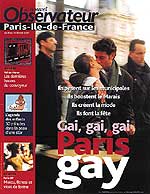
What better example than the Marais area to illustrate the growing influence of gays — an estimated 10 percent of the overall population — on Paris’ politics, fashion and nightlife. When its first gay bars opened in 1978, it was no more than a decrepit no-man’s-land at the center of Paris. Now le Marais is the capital’s liveliest neighborhood, a meeting place for homosexuals from all corners of France and abroad as well as heterosexuals.
“Le Marais’s true accomplishment probably is to have spurred provincial towns to reconsider their old value systems, as more and more boast their own Marais,” Le Nouvel Observateur writes in its February 8 issue.
This could also be a sign that the times are changing. In 1996, Jean-Charles Krieg, the 4th arrondissement mayor, had attempted to ban rainbow flags from Marais shop windows and bars. At the latest Lesbian and Gay Pride parade, in June, politicians running for office were fighting to stand at the front.
“Having a gay candidate on one’s electoral list is more than a race for votes,” the magazine writes. “It’s a token of modernity.”
Sirven’s black list
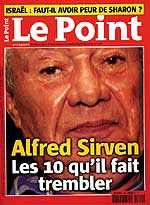
After police found the address book of Alfred Sirven, arrested earlier this month in the Philippines and suspected of 1.5 billion franc embezzlements, a number of influential names reverberated in the press, hinting ominously that if this financial Samson were to speak, the walls of the Palais Bourbon would start to shake.
“I could give away a hundred names... but that’s not what I want,” Sirven warned shortly after his arrest. “I consider myself a ‘State witness.’ I have nothing to say for now. If anybody pressures me to speak, it will be at their own risk.” Sirven was second man to Elf president Loïk Le Floch-Prigent from 1989 to 1993.
In its February 9 issue, Le Point draws up a list of ten political and financial figures Sirven’s return to France threatens. Included are former ministers Roland Dumas, Dominique Strauss-Kahn (both of whom are currently on trial in related cases) and Charles Pasqua as well as former German chancellor Helmut Kohl.
French farmers hit hard by recent developments
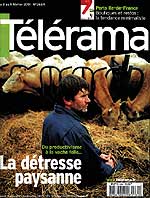
The cover picture of Télérama’s February 3 issue speaks for itself. France’s farmers are in a state of distress as an age-old system undergoes bitter transformations and food scandals are turning consumers against the hand that feeds them.
“[Farmers] consented to adopt a mass production model which could eventually cause their downfall,” Télérama writes. “Sociologist and experts already speak of ‘agriculture without farmers’.”
France’s agriculture, second only to the United States in production and exports, is a prey to its own development (BSE spreading, genetically modified food, etc.). Farmers feel trapped between quality standards, pressure from environmentalists and production demands. Today farmers constitute no more than 4% of France’s workers, and the suicide rate in that social category is unusually high.
“The agricultural world didn’t realize early enough that mass production was dispossessing farmers of their history, their practical knowledge and their dignity,” says one farmer.
Télérama argues that consumers have also played a part in generating the crisis, by pressing retailers for low prices regardless of concern for quality.
“If French households agreed to pay an extra franc per meal and per person, we’d have the means to restore our products’ quality and safety as well as mutual trust,” suggests another farmer.
Besançon and Lyon top cities in France, Paris 24th
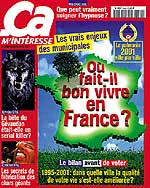
Paris dropped to 24th — down from 13th last year — in Ça m’Intéresse’s yearly ranking of French towns, based on quality of life. The study rates the country’s 35 largest agglomerations in terms of air and water, public transportation, waste disposal, industrial and nuclear pollution, economy, sports activities and cultural life.
Besançon and Lyon tied for first place. while Dijon came third. At the bottom, Lille, Perpignan and Le Havre suffer either from high pollution, or stagnating economies.
Nice, Marseille and Lyon follow Paris as the cities where housing is most expensive. At the other end, Saint Etienne, Toulon and Brest are the most affordable according to the magazine.
“The only centralized European state”
As the ongoing debate over Corsica’s “special status” has been encouraging other French regions to press Paris for more autonomy, decentralization is once again at the heart of France’s political debate, 19 years after its administrative regions were first created.
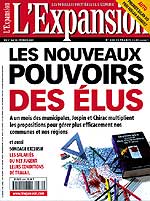
“Can France remain the only centralized European state when our British and Italian neighbors have just launched significant reforms?” L’Expansion asks.
In its February issue, the magazine explains that, if decentralization efforts bear fruit, increased local authority will give regional representatives more power on a national level, the habitation tax will disappear and communes will group around larger cities to form stronger agglomerations. France numbers 36,763 communes, compared with 16,068 in Germany, 8,074 in Italy and 444 in the UK.