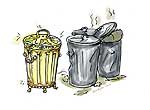
When prefect Eugène Poubelle overhauled garbage collection in Paris and made the garbage can mandatory in 1884, opponents to the law retaliated by giving his name to the much reviled boîte à ordures. So when the city launched its ambitious recycling program last summer, it spared no expense to sell Parisians on the idea that recycling was cool, community-spirited and environmentally correct.
Unlike major European and American cities, Paris comes relatively late to recycling. Lulled by the convenience of daily garbage collection, Parisians have had little incentive to recycle their yearly 1.2 million tons of refuse. But with the pressure of French and European recycling laws and the Paris municipal elections looming on the 2001 horizon, City Hall has suddenly shifted into high gear and embarked on the first phase of a three-year program which will bring Paris in compliance with a French law banning the use of landfills for disposal of residential recyclable material, as of July 1, 2002.
With 30 million Frenchmen already into recycling, France has the second highest rate of recyclage de déchets after Germany. So to motivate Parisians to join their countrymen, City Hall has launched an extensive and exhaustive 35-million franc campaign to promote its merits. The aim being to inspire and inform, not to make recycling compulsory. “If it’s mandatory, it won’t work,” say city officials, hoping to disprove the Parisians’ reputed propensity for indiscipline.
If Parisians are not inclined to pick up after their canines, they are more disposed to sort their household trash: 50% already recycle newspapers, magazines and glass — the city donates 20F per ton of glass recycled to the National Cancer Ligue (505,700F for glass recycled in 1999).
The first phase of the collecte selective as recycling is known in France, was implemented in five arrondissements (1,5,7,11, and 13) last June after a successful 18-month pilot program in the 13th arrondissement. Recycling will be extended to eight more arrondissements in September 2001, and the remaining seven in 2002, with a total projected cost of implementation of 150 million francs.
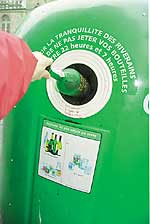
The Paris program is a four-bin, color-coded scheme: green for non-recyclables, blue for newspapers and magazines, white for glass and yellow for recyclable packages like cardboards, plastics, aluminum and tin cans. Lids are sealed and have specially-designed slots to prevent careless dumping of unsorted trash.
So will Parisians become “smart recyclers” and join “the cool recycling club,” as the city’s campaign posters playfully invite them to do? Most likely. Eugène Poubelle couldn’t have hoped for a more delectable posthumous victory.