Ask anyone in the world of style, and they'll tell you that textiles are the driving force behind today’s cutting-edge fashions. The introduction of Lycra, microfiber, heat stamping, coating, holograms, computer-generated prints, laser technology and special kinds of novelty weaving have revolutionized an otherwise humdrum era dominated by minimal apparel. Although tactile fabrics that interact optically with light have been around for some time, the trend for streamlined garments further underscores the allure of modern textile advances.
The Musée de la Mode et du Textile’s current show “Jouer la lumière” (Playing with Light) focuses on interactions between textiles and light. Antique attire rubs shoulders with the most recent creations, spotlighting a multiplicity of effects connected with the visual properties of various families of cloth such as taffeta, satin, damask, knits and lace. Traditional techniques alternate with contemporary embellishments from embroidery to plastic innovations.
The visitor is greeted by a spectacular gown from Jean Paul Gaultier couture. A tribute to the Eiffel Tower at the turn of this century. A symphony of gold crochet over lame, studded with glass beads... It’s decorated with tiny lights that glow at sundown. A fusion of past and present. Hand-executed crochet, adorned with miniature electrical circuitry.
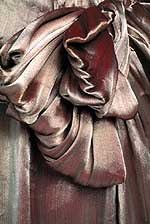
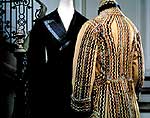
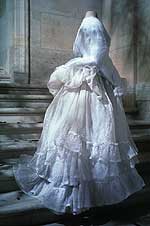
Setting number two harks back to a time when more subtle effects were employed. A Jeanne Lanvin dress dating from 1910 appears to be a solid mass, until its proud possessor moves about, revealing its airy, translucent silhouette achieved via several layers of cotton voile. We’re then transported to the 1980s, and confronted with polka dots, on a clear-cut vinyl raincoat by Popi Moreni. A simple design that produces the illusion of motion as dime-sized circles — both on the outer surface and underside — dance about in synch with the wearer’s movements. This 20th century fashion odyssey also zigzags from one classic special effect to the next. First, crushed and cut or carved velvets. Next, the iridescence of taffeta. And the hypnotic sparkle of sequins, moiré and intricate embroidery.
The exhibition features several interesting pit stops. Among others, Issey Miyake’s woven and pleated wonders. And, François Lesage’s grand embroideries adorning an entire dress that positively blooms, aglow with an imaginary beaded vegetation. You'll marvel at what looks like pepper, sprinkled over a Madeleine Vionnet cowl neck gown: an illusion obtained with minuscule black beads generously deployed on the top, then gradually dispersed over the hips, before petering out to reveal the design’s warm coral-hued skirt.
One of the most spectacular modern-day inventions is the use of laser cutting which has given birth to a new generation of lace and novelty styles. On view is a length of fabric flecked with 3D leaves, creating the impression of a forest floor during the fall.
The presentation ends with a glimpse at the new millennium seen through the eyes of 1960s designers. At center stage, Paco Rabanne with dress constructions made of metallic elements and plastic tubing. Mixed in with this futuristic tableau, more metalware... Francois & Bernard Baschet’s heavy metal dresses devised for ’60s cult movie “Where Are You, Polly McGoo?”. And more Issey Miyake, with his “gold leaf” flannel jumpsuit, followed by a “shattered, mirrored” mosaic frock by Angelo Tarlazzi for Guy Laroche (1991).
To Dec 31, Tue- Fri 11am to 6pm (Wed to 9pm, Sat & Sun 10am to 6pm), Musée de la Mode et du Textile, 107 rue de Rivoli, 1er, M° Palais-Royal, tel: 01 44 55 57 50, 35F/30F
Dutch Modernism: Fashion from the Netherlands
Among the designers featured in the fashion museum expo, Victor & Rolf is also present in another thematic exhibit highlighting “Dutch Modernism,” to be seen at the Institut Néerlandais until March 11. Baroque exuberance vs. ascetic minimalism (and everything else, in between) is the subject of this comprehensive overview. Fashion in the Netherlands is a paradox because, on the whole, this country has never really shown an interest in fashion. However, to the surprise of many, a small group of Dutch men and women designers including Alexander Von Slobbe, Victor & Rolf, and Ronald von der Kemp, have made a name for themselves on the international scene.
For the most part, their approach is highly conceptual and experimental. What happens when you move a seam from point A to point B? What happens when you abstract a form, or push contrasting shapes within the same silhouette? Already well established on the Paris scene — for more than a decade, now — with his “SO” and “Orson & Bodil” labels, Alexander Von Slobbe walks the fine line between art and commercial clothes. A traditional-lined man’s jacket, with earthy, Mark Mulders-inspired floral cum fauna artwork scribbled all over it, is rough-cut out of jute. Another guy’s suit is tailored in black, “toxic green” neoprene.
In the basement, the exhibit turns into a galley space where garments with intriguing cuts, details or contrasting texture treatments are displayed alongside photos by Marcel van der Ulugt and Miss Liz Wendelbo. To Mar 11, Tue-Sun 1-7pm (closed Mon), “Dutch Modernism: la mode en version Néerlandaise,” Institut Néerlandais, 121 rue de Lille, 7e, M° Assemblée Nationale, tel: 01 53 59 12 40, 20F/10F