Robert Lepage was born in 1957. This simple fact couldn’t be more ordinary, but such is the creative genius of Quebec’s resident theater visionary: from the most commonplace detail, he works the most unearthly magic.
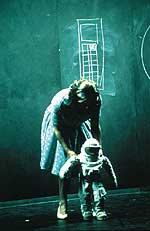
In “La face cachée de la lune” (“The Far Side of the Moon”), which premiered at the Henson International Festival of Puppet Theater in New York last August and stops briefly at the Maison des Arts de Créteil this month, the coinciding of Lepage’s birth with Sputnik’s launch is fuel for an alternately moody and fanciful tale of heroes, space exploration and the individual’s struggle to find his place in the cosmos, brought to life by Lepage’s awe-inspiring technological wizardry.
The play tells the stories of two brothers, André and Philippe, in the aftermath of their mother’s death. The former is a famous radio weatherman; the other hears voices and is trying to communicate with extraterrestrials. Their sibling rivalry and aspirations soon take on larger dimensions played out against the backdrop of the defining dream of the 20th century: the voyage to the moon. Aided by puppets, archive films, gravity-defying special effects and a celestial score by Laurie Anderson, Lepage travels in this solo show through both the charged atmosphere of the US/Soviet space race and his own shadowy regions as a child afflicted with the rare disease alopecia, which causes complete hair loss and probably made the young Lepage feel like an alien among his peers.
Lepage’s uncanny talent for playing multiple roles and working wonders out of the prosaic was forged at once during his studies under Alain Knapp in Paris in the 1970s and throughout his subsequent work with Quebec’s experimental troupe Théâtre Repère; from the one he learned to regard writing, directing and acting as a single creative act and from the other to develop a show from a single tangible object. With a penchant for revealing parallel realities and the interconnectedness of human experience, he soon became the driving force of Repère, and his skating, dancing “Dragon’s Trilogy” (1985), about Chinese immigrants in Quebec City, put his name squarely on the theater map. Commissions from the Royal National in London, the Tokyo Globe, the Canadian Opera and the Royal Dramatic Theatre of Stockholm followed, but in 1993 he chose to come back to Quebec to form his own company, Ex Machina.
Today Lepage has created some 30 shows and films, drawing on history, multiple languages and cultures, and his personal life, including the harrowing “Polygraph” (1987) about his nightmarish experiences as a suspect in the brutal rape and murder of his best friend, “The Geometry of Miracles” (1997), which investigates mysticism and architecture bringing together the American architect Frank Lloyd Wright and the Russian mystic Georgi Gurdjieff, and perhaps his best known work, “The Seven Streams of the River Ota” (1994), a three- year-in-the-making, seven-hour-long epic using Bunraku puppets, Noh masks, documentary footage and video, that jumps around the stories of 30 characters on three continents, telescoping the death and destruction caused by the atom bomb, the Holocaust and Aids while exploring mankind’s ability to live on and renew itself.
A polyglot, Lepage who was raised on both sides of Quebec’s Anglo-French divide, is nowhere more at home than in the interstices of our ever-shrinking wired world, finding in the cultural exchanges of globalization a way back to our most authentic, human selves. Multi-talented and thoroughly modern in his innovative applications of today’s tools of performance, he is one of contemporary theater’s most exciting creators. In “La face cachée de la lune” he takes us once again on a voyage to the incredibly fertile recesses of an imagination born at the dawn of man’s exploration of the final frontier.
Mar 15-18, Thu-Sat 9pm, Sun 3:30pm, Maison des Arts de Créteil, place Salvador Allende, 94000 Créteil, Mº Créteil Préfecture, 55-100F, tel: 01 45 13 19 19