 “Paris-Chien: adventures of an ex-pat dog,” a charming and engaging new book by Jackie Clark Mancuso, tells the tale of a Norwich Terrier’s year in Paris. From home sickness to French lessons to the struggle to make Parisian friends this book carries a message for children about how to cope with change in their lives. With a number of French words in the text, the book is a light intro to the language. Illustrated with colorful gouache paintings of Paris streets, parks, markets and cafes, the story will entertain children (and adults) who like dogs and Paris. “Paris-Chien” is Mancuso’s first book. You can visit her illustration website at http://jackiemancuso.com The book is available at amazon


 Excerpted from
  Your success or failure in finding a suitable rental property depends on many factors, not least the type of rental you’re seeking (a one-bedroom apartment is easier to find than a four-bedroom detached house), how much you want to pay and the area. France has a strong rental market in most areas, although rural properties are rarely available for long-term rental.
  Often, the term “Pygmalion” is used to describe artist, Jean-Paul Goude and the intimate rapport he has with his muses. However, instead of sculpting object of desires out of stone, Goude transforms women with whom he cultivates a relationship into his living, breathing works of mythical art. Call it “Goudemalion,” a term reflected in the Musee des Arts Decoratif’s latest exhibition paying homage to the brilliant mind of image maker/art director, Jean-Paul Goude.
 Diane Arbus (1923–1971) once said “A photograph is a secret about a secret. The more it tells you, the less you know…” The same could be said about Arbus herself. Although this enigmatic photographer has become one of the world’s most influential artists, considerable mystery surrounds her controversial work. Now a 200 picture retrospective at Paris’ Jeu de Paume, including two library-like rooms with notebooks, cameras, contact sheets, books from her home and studio and family pictures, provides some new insights.
 While Paris has been making history in plain view a lot has happened under the paving stones. Located south of the former city gate (the “Barrière d’Enfer” at today’s Place Denfert-Rochereau), a subterranean labyrinth of former quarries holds the remains of six million Parisians, moved there after a decision in the late 18th century to close cemeteries within the city walls for reasons of public health. Opened in the late 18th century, the underground cemetery became a tourist attraction on a small scale from the early 19th century, and has been open to the public on a regular basis from 1867. This guide written by Gilles Thomas with photographs by Emmanuel Gaffard takes us through the vast ossuary maze of sombre galleries and narrow corridors laden with walls of bones where limestone was once mined. The official name for the catacombs is l’Ossuaire Municipal. Although this cemetery covers only a small section of underground tunnels comprising “les carrières de Paris” (“the quarries of Paris”), Parisians today often refer to the entire tunnel network as “the catacombs”. A fascinating guide to the dark side of the city of light. J.M
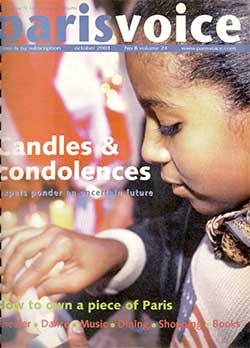 For the 9/11 anniversary we are re-running a commentary written by Parisvoice’s David Applefield on how this event was experienced by American expats in Paris at that time. The edition with these observations appeared two weeks after 9/11.